
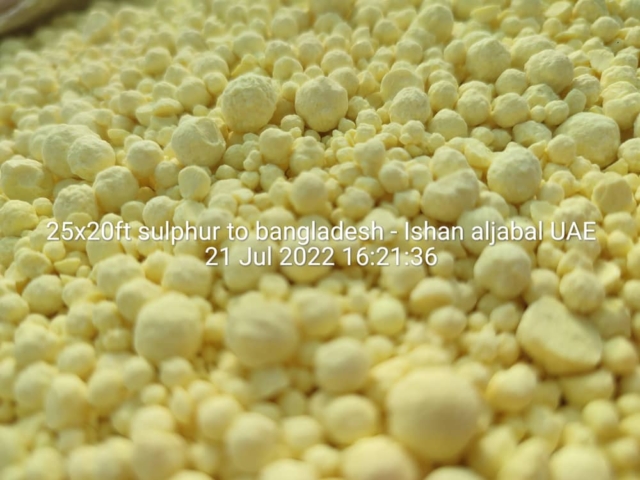
Sulphur is the quiet workhorse of modern industry. Nobody puts it on a billboard. Yet without it, your phosphate fertilizer doesn’t get made, your metals don’t get leached, and a good chunk of the battery supply chain stalls.
So who actually supplies the stuff in 2026? And where does a name like Aljabal Holding land on that map? Let’s dig in.
Why Sulphur Matters More Than Ever in 2026
Think of sulphur as the salt of heavy industry. A pinch goes into almost everything, and when it gets scarce, everybody feels it.
The Fertilizer Connection
Most sulphur ends up as sulphuric acid, and most of that acid turns phosphate rock into fertilizer. That’s why big phosphate producers like Morocco’s OCP are among the world’s largest buyers. When farmers need more crop nutrients, sulphur demand follows, whatever the economy is doing.
The New Energy Twist
Here’s the newer wrinkle. Analysts at SMM expect global sulphur demand to grow by roughly 2% in 2026, driven by rigid agricultural needs and by a ramp-up across the new energy industry chain. In plain English, batteries and clean-tech materials are now competing with farms for the same yellow rock.
The State of the Global Sulphur Market
If you’ve bought sulphur this year, you already know the mood: tense.
Supply: Tight and Concentrated
SMM describes the industry as resource-driven and highly concentrated, with the Middle East acting as the heart of global supply. The reason is geological. Gulf countries sit on sour, sulphur-rich gas, and recovering sulphur from it is basically a by-product business.
The same SMM survey suggests total 2026 supply of around 82 to 83 million tonnes, with only about 2.6 million tonnes of incremental supply. That’s not much room to breathe.
Russia’s story adds drama. It used to export 3–4 million tonnes a year, but it flipped to net importer, buying 35,000 tonnes abroad in October 2025. A former heavyweight became a buyer. That reshuffled trade flows across Europe and the Black Sea.
Prices: Record Territory
Want a number? ADNOC raised its June 2026 sulphur price to $860 per tonne FOB Ruwais for the Indian subcontinent, up $100 from May. SMM called it an all-time high. Other Gulf producers weren’t far behind, with QatarEnergy and Kuwait’s KPC both at $805 per tonne FOB for the same month.
Those are June figures, so check current quotes before you budget anything. But the direction of travel is clear.
The Heavyweights Setting the Pace
Before we talk about any smaller name, you need to know who sets the benchmark. Their decisions ripple through every trader’s price sheet.
ADNOC
The Abu Dhabi National Oil Company is the headline name. ADNOC has described itself as the world’s largest sulphur exporter, and it and its partners produce more than 6 million tonnes annually, shipping from handling facilities in Ruwais.
There’s also a structural story. Back in 2024, S&P Global reported that traders were being told to coordinate with ADNOC Trading for cargoes from January 2025, a signal that sales were being centralized. If you buy Gulf sulphur, that matters.
Saudi Aramco
Aramco is the other giant. SMM puts its designed sulphur capacity above 6 million tonnes a year, with around 4.5 million tonnes produced in 2024. Aramco’s gas expansion, including projects like Marjan, tends to add more sulphur to the pile over time.
QatarEnergy and Kuwait’s KPC
These two don’t always grab headlines, but they’re price-setters in their own right. When they publish monthly prices, the whole Gulf market recalibrates. Their numbers sit close to ADNOC’s, which is exactly what you’d expect in an oligopoly.
Kazakhstan’s Big Two
Kazakhstan is the wildcard. It exported over 5 million tonnes in 2024, more than 20% of global trade. Production there leans on two fields: Tengiz and Kashagan together account for more than 90% of national output. That makes Kazakh supply powerful but dependent on a very small number of operations.
So, Where Does Aljabal Holding Fit?
Now to the name in your topic. I’ll be straight with you: I couldn’t find evidence placing Aljabal Holding alongside ADNOC or Aramco as a producer. No capacity figures, no published offtake deals, no company profile with volumes.
That doesn’t mean the company is unimportant. It means the public record doesn’t support big claims. And in a commodity business, claims without paperwork are worth very little.
What the Public Record Shows
The only relevant trace I found was a trade-data listing, and I can’t confirm it’s the same group.
The Jebel Ali Trade Footprint
A trade-intelligence site lists an entity called Al Jabal, based in in Dubai and tagged for crude sulphur imports and exports. The same listing shows its last recorded transaction in July 2025.
Is that company linked to Aljabal Holding? I can’t say. Names like this are common across the Gulf, and a similar-sounding trading entity isn’t proof of a corporate relationship. Treat it as a lead to verify, not a fact.
How to Vet Any Sulphur Supplier
Whether it’s Aljabal or anyone else, the test is the same. The sulphur market has plenty of traders and few producers. Your first question should always be: are you buying from the molecule’s owner, or from someone reselling it?
The Due Diligence Checklist
- Ask for origin. Which refinery or gas plant does the cargo come from?
- Request the company registration and match it to the legal entity on your contract.
- Check recent shipments. Bills of lading and trade records show whether a supplier actually moves volume.
- Get a sample and a certificate of analysis. Purity and moisture matter, especially for granulated or formed sulphur.
- Confirm the form and Incoterms. Prilled, granular, or liquid? FOB, CFR, or something else?
- Call a past customer. One honest reference beats ten brochures.
Risks Buyers Should Watch in 2026
Let’s be real: this isn’t a calm market.
Logistics pressure. One 2026 industry summary notes that disruption tied to the Iran conflict and the Strait of Hormuz raised pressure on Gulf logistics. A huge share of the world’s sulphur leaves through that region, so shipping hiccups quickly become price spikes.
Counterparty risk. When prices run to records, opportunists appear. Brokers with no cargo, paper-only offers, and “too good to be true” quotes all multiply.
Policy shifts. Export rules, tender structures, and sales-channel changes can alter availability fast. Kazakhstan’s Kashagan, for example, was reported to run an export tender with a two-year term starting February 2026, which shows how contract structures keep evolving.
Price volatility. Monthly Gulf prices can jump or drop by $100 in a single cycle. Fixed-price commitments without a plan are risky.
Practical Buying Tips
You can’t control the market. You can control how you show up in it.
- Diversify origins. Don’t hang your plant on a single source. Mix Gulf, Central Asian, and other supply where possible.
- Lock in term contracts with a base supplier, then top up on the spot market.
- Build stock buffers if your storage allows. Even two extra weeks of cover can save you in a squeeze.
- Use payment protections. Letters of credit exist for a reason.
- Track benchmarks monthly. Watch ADNOC, QatarEnergy, and KPC announcements, since they anchor everything else.
What Comes Next for the Sulphur Trade
Expect continued tightness. SMM sees demand outpacing supply in 2026, and the new-energy push adds a fresh layer of appetite on top of fertilizer. Meanwhile, the Middle East is the only region capable of large, stable output, according to the same analysis, which keeps pricing power concentrated.
For mid-sized players, including holding groups and traders, the opportunity lies in service: reliable logistics, storage, blending, and regional distribution. For a company like Aljabal Holding, that could be a sensible lane. But any claim of leadership should show up in documents, not slogans.
Conclusion
The leading sulphur suppliers of 2026 are the national oil and gas giants. ADNOC, Saudi Aramco, QatarEnergy, KPC, and Kazakhstan’s major fields set volumes and prices, and everyone else works around them. Prices have hit records, supply growth is thin, and logistics risk is real.
As for Aljabal Holding, I found no public evidence that it ranks among those leaders, only an unconfirmed trade-listing trace. If you’re considering buying from it, or partnering with it, ask for proof of origin, recent shipments, and lab certificates. In a market this tight, the right supplier is the one who can show you the cargo, not just tell you about it.
FAQs
1. Who are the biggest sulphur suppliers in 2026?
The Middle East dominates, led by ADNOC and Saudi Aramco, followed by QatarEnergy and Kuwait’s KPC. Kazakhstan is also a major exporter, thanks to Tengiz and Kashagan.
2. Is Aljabal Holding a leading sulphur supplier?
I couldn’t verify that. I found no published capacity, contracts, or volumes tying Aljabal Holding to the top tier, so confirm directly with the company and request documentation.
3. Why are sulphur prices so high in 2026?
Supply growth is limited, demand is rising from fertilizer and new-energy uses, and Gulf logistics face pressure. ADNOC’s June 2026 price reached $860 per tonne FOB Ruwais, a record according to SMM.
4. How can I check whether a sulphur supplier is genuine?
Verify company registration, ask for the cargo’s origin, review shipment records, get a certificate of analysis, and speak to past customers before sending payment.
5. What is sulphur mainly used for?
Mostly sulphuric acid, which drives phosphate fertilizer production. It’s also used in metal processing, chemicals, and increasingly in new-energy supply chains.